


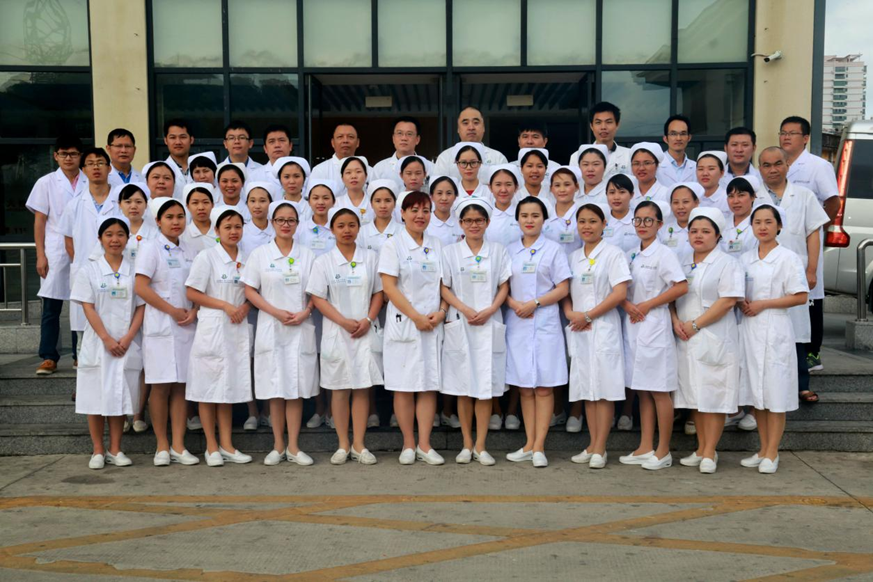
Sanya Central Hospital (The Third People's Hospital of Hainan Province) is formerly known as Hainan Nongken Sanya Hospital. The Neurosurgery Department was established in 1988. It is the earliest-established neurosurgery specialty in southern Hainan, and also one of the only three neurosurgery specialties during the establishment of Hainan Province (the others being the Neurosurgery Department of Hainan Provincial People's Hospital, the Neurosurgery Department of the Affiliated Hospital of Hainan Medical University, and the Neurosurgery Department of Sanya Hospital of Hainan Nongken). In 1989, the department, together with Hainan Provincial People's Hospital Neurosurgery, co-founded the Neurosurgery Branch of the Hainan Medical Association. Professor Li Yingda, then Director of the department and Vice President of the hospital, served as the Vice Chair. Over the years, under the leadership of successive directors and the collective efforts of the team, the department has grown significantly and established a solid foundation for its development. Today, it is the largest neurosurgery department in southern Hainan, with a strong reputation and influence both within the province and nationally. The department comprises two wards and a dedicated neurosurgical intensive care unit (ICU), with a total of 80 beds (including 15 specialized neurosurgical ICU beds). The department currently has 17 medical professionals (2 senior professional titles, 8 associate senior professional titles, 3 intermediate professional titles, and 4 primary professional title physicians) and 38 nursing staff (20 supervisor nurses, 15 senior nurses, and 5 nurses).
Subspecialty Clinical Features:
(1) Neuro-Oncology Subspecialty Group: Specializes in surgical treatment for various nervous system tumors, including meningiomas, gliomas, pituitary adenomas, acoustic neuromas, congenital tumors, craniopharyngiomas, metastatic tumors, hemangioblastomas, and spinal cord tumors. The team also handles complex cases such as skull base tumors, intraventricular tumors, intramedullary spinal cord tumors, and multi-segment spinal canal tumors, often combining surgery with radiotherapy and chemotherapy for optimal outcomes.
(2) Cerebrovascular Disease Subspecialty Group: Specializes in the treatment of hemorrhagic cerebrovascular diseases (e.g., intracranial aneurysms, cerebrovascular malformations, arteriovenous fistulas) and ischemic cerebrovascular diseases (e.g., carotid artery stenosis, vertebral artery stenosis, subclavian artery stenosis, intracranial artery stenosis), as well as conditions such as moyamoya disease and venous sinus thrombosis. The department excels in both open craniotomy and endovascular neurosurgical interventions, demonstrating outstanding comprehensive treatment capabilities. The team has extensive experience in endovascular interventions, microsurgery for ventricular vascular diseases, vascular bypass procedures, and carotid endarterectomy.
(3) Traumatic Brain Injury Subspecialty Group: Specializes in managing complex and severe traumatic brain injuries, including skull base injuries, vascular injuries, and penetrating brain injuries. The team has extensive experience in treating complications such as post-traumatic skull defects, hydrocephalus, cerebrospinal fluid leaks, and traumatic epilepsy, achieving excellent outcomes. They are highly skilled in advanced techniques such as post-traumatic neuroprotection, mild hypothermia therapy, and intracranial pressure monitoring.
(4) Functional Neurosurgery Subspecialty Group: Specializes in treating functional neurological disorders such as Parkinson’s disease, epilepsy, trigeminal neuralgia, and hemifacial spasm, with expertise in managing complex cases. The department has achieved excellent outcomes in deep brain stimulation (DBS) for Parkinson’s disease, surgical treatment for trigeminal neuralgia, hemifacial spasm, epilepsy, and other movement disorders, establishing a leading position in Hainan Province and the southern Hainan region.
(5) Pediatric Neurosurgery and Congenital Nervous System Disease Subspecialty Group: Provides surgical treatment for pediatric neurological disorders across all age groups, including craniocervical junction anomalies, basilar invagination, Chiari malformation, meningoencephalocele, myelomeningocele, hydrocephalus, arachnoid cysts, and craniosynostosis.
(6) Spinal Neurosurgery Subspecialty Group: Specializes in treating spinal and spinal cord tumors, spinal cord injuries, spinal vascular diseases, syringomyelia, and tethered cord syndrome.
(7) Neurocritical Care Subspecialty Group: Operates a dedicated 15-bed neurosurgical ICU with an independent specialized medical team. The group focuses on maintaining vital signs, protecting neurological and organ functions, and providing advanced care for critically ill patients, ensuring robust support for emergency and severe cases.
(8) Neurorehabilitation Subspecialty Group: Pioneers new techniques such as coma arousal surgery and enhanced recovery after surgery (ERAS) in neurosurgery. The team also specializes in rehabilitation surgeries for stroke-related hemiplegia, spastic paraplegia, and facial paralysis.
Specialized Equipment:
The department is equipped with advanced medical devices, including one Leica OH5 surgical microscope, one Zeiss microscope, video EEG, STORZ neuroendoscopy, a GE angiography system, Aesculap cranial power systems, Anke stereotactic devices, and intracranial pressure monitors. These tools meet the needs of all specialized technical procedures, with some equipment (e.g., intracranial pressure monitors, bedside video EEG) being among the most advanced in the province. The hospital also has comprehensive diagnostic and imaging facilities, including a medical imaging department (equipped with 1.5 T and 3.0 T MRI machines, 64-slice, and gemstone CT scanners), an ultrasound department, a clinical laboratory, and a functional department (electrophysiology). The catheterization lab is equipped with a GE angiography system.
Honors and Academic Achievements:
The department has received numerous awards from the Nongken system, the Health Commission, and the hospital. It has won one Hainan Provincial Science and Technology Progress Award (Second Prize, first author), two Hainan Provincial Science and Technology Progress Awards (First Prize, fourth and fifth authors), one Central South University Medical Achievement Award (Second Prize, first author), one Sanya Science and Technology Progress Award (First Prize, first author), and one Sanya Science and Technology Progress Award (Fourth Prize, first author). The team has published over 100 academic papers, contributed to 7 monographs, and holds 4 utility model patents.
Department Culture:
Since its establishment, the Neurosurgery Department of Sanya Central Hospital (The Third People's Hospital of Hainan Province) has thrived with the support of hospital leadership and collaboration with other departments. Through the dedication of its leaders and staff, the department has continuously strengthened its competitive edge, achieving the goal of "offering what others lack, excelling where others are competent, and perfecting where others have already excelled." This has enhanced the department’s credibility, reputation, and patient satisfaction. The department has cultivated a culture of "dedication, diligence, unity, and progress," driving its ongoing development and success.


