


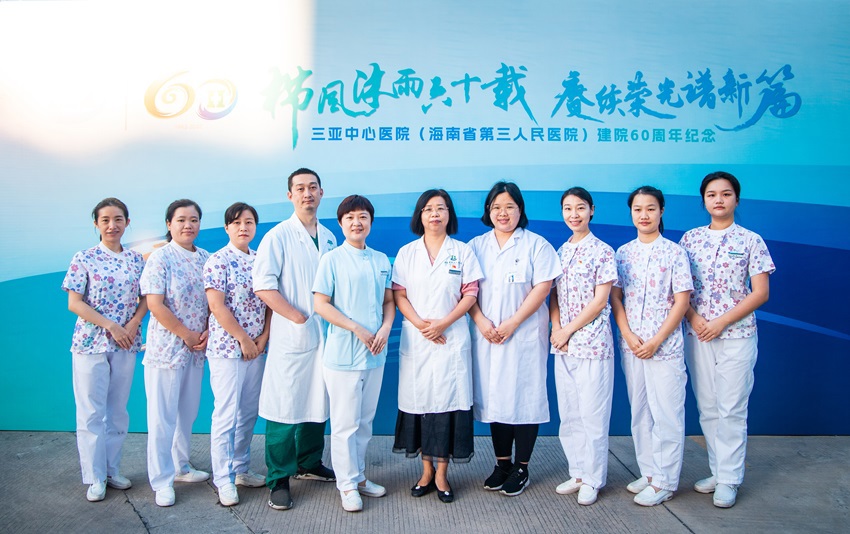
The Nephrology Department of Sanya Central Hospital (The Third People's Hospital of Hainan Province) was established in the early 1980s. It currently has 35 beds and 16 medical staff, including 1 chief physician, 1 associate chief physician, 4 attending physicians, and 3 supervisor nurses.
The department diagnoses and treats the following conditions: 1. Primary glomerular diseases: acute and chronic glomerulonephritis, nephrotic syndrome, rapidly progressive glomerulonephritis, and latent glomerulonephritis. 2. Tubulointerstitial diseases: renal tubular acidosis, interstitial nephritis, reflux nephropathy, obstructive nephropathy, and polycystic kidney disease. 3. Urinary infections: urinary tract infections and renal tuberculosis. 4. Acute renal failure and chronic renal failure (uremia). 5. Secondary kidney diseases: diabetic nephropathy, hypertensive nephropathy, renal amyloidosis, and gouty nephropathy. 6. Rheumatic diseases: systemic lupus erythematosus, rheumatoid arthritis, ankylosing spondylitis, dermatomyositis, scleroderma, osteoarthritis, and gouty arthritis.
The department is equipped with advanced medical devices, including automated peritoneal dialysis machines, centrifuges, osmometers, phase-contrast microscopes, electrocardiogram (ECG) machines, patient monitors, and intravenous infusion pumps.
Routine procedures include peritoneal dialysis catheter placement, renal biopsy, arteriovenous fistula creation, long-term internal jugular vein catheterization, temporary central venous catheterization, and manual/automated peritoneal dialysis.
The department’s laboratory conducts tests such as blood osmolarity, urine osmolarity, and urine component analysis.
New Techniques and Projects
Trocar-assisted peritoneal dialysis catheter placement: Developed by Professor Zhu Bai of Central Hospital of Jilin City, this technique uses a trocar for catheter insertion, minimizing trauma, enabling immediate full-volume dialysis post-surgery, and reducing complications. After training under Professor Zhu Bai, the department’s team independently performs this procedure, which simplifies traditional open surgery by eliminating the need to incise and suture the posterior sheath and peritoneum. The technique results in smaller incisions, less intraoperative bleeding, fewer postoperative complications, and shorter surgery times. The trocar can be sterilized and reused, adding no extra cost and offering high cost-effectiveness. The department has independently completed over 200 cases, filling a gap in Sanya’s medical capabilities.
Through years of dedicated efforts, the department has become a comprehensive, technically proficient, well-equipped, and service-oriented specialty, earning a strong reputation in southern Hainan and the surrounding areas of Sanya. It is recognized as the leading kidney disease treatment center in southern Hainan.


