


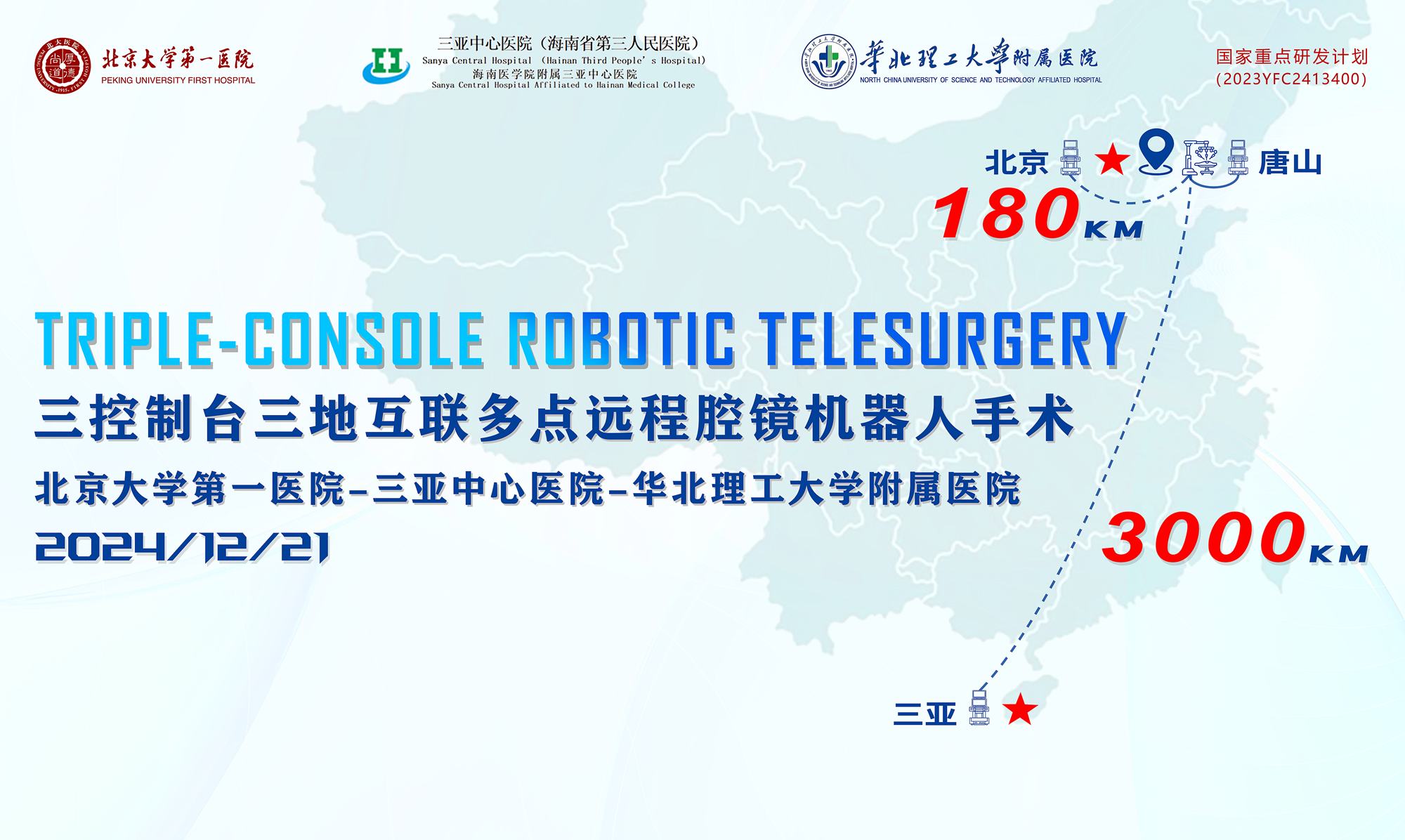
At 9 AM on December 21, in the operating room of Sanya Central Hospital (The Third People's Hospital of Hainan Province), a remarkable remote laparoscopic robot-assisted radical prostatectomy was in progress. The patient was in the Affiliated Hospital of North China University of Science and Technology. Experts from Sanya Central Hospital and Peking University First Hospital closely cooperated remotely through the doctor's console and successfully completed the surgical operation. The remote control during the operation was extremely smooth without obvious lag, successfully ensuring the complete success of the operation. This has laid a solid foundation for the development of remote surgery in Sanya Central Hospital, allowing local patients to enjoy top-notch medical technology without having to travel.
To ensure the smooth progress of this remote surgery, Peking University First Hospital, Sanya Central Hospital, and the Affiliated Hospital of North China University of Science and Technology joined forces and carefully formulated a comprehensive and detailed implementation plan. Before the operation, the medical team conducted a comprehensive assessment of the patient and fully communicated with the family members to obtain informed consent for the operation. Meanwhile, the technical team conducted a comprehensive and detailed inspection and debugging of the surgical robot and formulated a complete emergency surgical plan to effectively respond to emergencies such as network interruption and delay. It ensures that in case of an emergency, the control of the robotic arm can be seamlessly switched to the slave-side doctor's console to ensure the safety of the operation.
During the operation, Chen Guoqiang, Assistant to the President of Sanya Central Hospital and Director of the Department of Urology, sat at the remote console. With rich experience and exquisite technology, he skillfully controlled the robotic arm. With the help of the high-definition 15-times magnified three-dimensional (3D) visual field transmitted by the 5G network, Director Chen Guoqiang carried out precise and complex operations such as cutting, suturing, and tissue removal on the patient on the operating table. The members of the surgical team were fully concentrated and monitored the progress of the operation in real time. The medical staff of the Affiliated Hospital of North China University of Science and Technology closely monitored the patient's vital signs on the spot. All parties cooperated closely, and the operation was completed safely and smoothly.
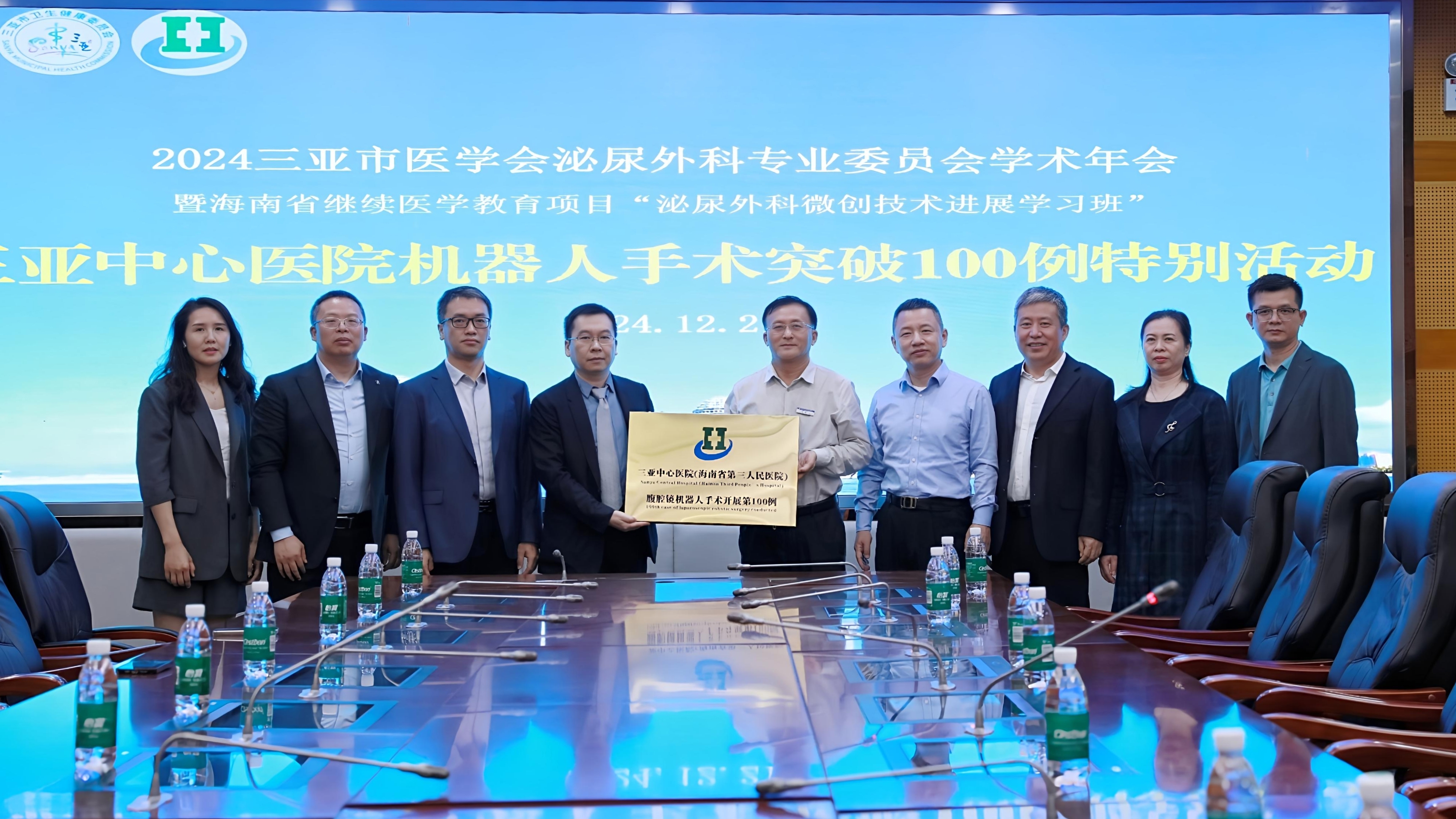
Wang Tiansong, President of Sanya Central Hospital, said, "Malignant tumors have always been the number one killer threatening people's health. Robotic surgery is a powerful weapon to combat malignant tumors. However, in the past, only a few hospitals in Hainan Province could carry out it, and the cost was extremely high, so ordinary people could only shy away. Under the leadership of the Sanya Municipal Party Committee and the Municipal Government and with the strong support of the Sanya Health Commission, Sanya Central Hospital efficiently used special funds and organized technical research. In less than half a year, this robot has completed a total of 100 robotic surgeries in four departments, namely Urology, Gynecology and Obstetrics, General Surgery, and Thoracic Surgery. The vast majority of them are malignant tumors. This is a specific measure taken by Sanya Central Hospital to implement the people - centered concept of health, achieve high-quality development, introduce and learn new productive forces, and overcome the most urgent, difficult, worrying, and expected health problems of the masses."
In the urology department of the hospital, 50 surgeries have been completed using the laparoscopic robot. The scope of surgeries has covered all minimally-invasive laparoscopic surgeries that can be carried out in the urology department. Minimally-invasive surgeries such as robot-assisted radical prostatectomy, total cystectomy with orthotopic neobladder, radical nephrectomy, nephron-sparing partial nephrectomy for renal tumors, adrenal pheochromocytoma resection, pyeloplasty, ureteroplasty, and partial cystectomy have been completed. The vast majority of the surgeries are tumor resection surgeries, which have become the routine surgical method for treating tumors in the urology department. Through the high - definition visual field and 15-times magnification display of the surgical robot, the tumor boundary and pre - treatment of blood vessels can be clearly identified, reducing surgical bleeding, greatly improving the level of minimally-invasive treatment of tumors, and enhancing the accuracy of minimally-invasive tumor surgeries. Through remote robot-assisted surgeries, our hospital has sincerely cooperated with Peking University First Hospital, allowing patients in Hainan to enjoy surgeries by top domestic experts without leaving the island. Meanwhile, it has improved the level of robotic surgery in the urology department of our hospital and the level of discipline construction.
In the field of Gynecology, robotic laparoscopic surgery has steadily entered the stage of mature and proficient application from the initial exploratory stage. The types of surgeries have gradually expanded from single to multiple. Currently, various adnexal surgeries, uterine fibroids surgeries, a variety of complex hysterectomy surgeries, and other gynecological surgeries are routinely carried out, basically covering the surgical treatment scope of common gynecological diseases, providing more accurate and minimally-invasive treatment options for the majority of female patients.
In the Thoracic Surgery Department, the hospital has successfully carried out a variety of high-difficulty surgical procedures such as robot-assisted radical resection of the left upper lung and radical resection of lung segment lung cancer. The successful completion of the left upper lobectomy with lymph node dissection marks a breakthrough in the application of robotic surgery in the thoracic surgery department of the hospital, significantly improving the technical level and treatment ability of the hospital in the field of thoracic tumor treatment.
In the General Surgery Department, the hospital has also actively explored the application and expansion of robotic surgery technology and has carried out robot-assisted laparoscopic radical resection of colorectal cancer. The high-definition visual field and 15-times magnification visual field of the robot are more conducive to determining the tumor margin, enabling more accurate tumor resection and avoiding tumor residue, greatly improving the level of minimally-invasive treatment of colorectal cancer in the department.
Feng Wu, Party Secretary of Sanya Central Hospital, said that looking ahead to the path of future medical innovation and development, Sanya Central Hospital will continue to uphold the spirit of bold exploration and innovation, deeply tap the application potential of telemedicine, and continuously expand its application boundaries and scenarios. The hospital will further strengthen exchanges an The hospital will further strengthen exchanges and cooperation with high-quality medical resources at home and abroad. Through multi-dimensional cooperation models such as technology sharing, talent cultivation, and scientific research collaboration, it will continuously improve medical technology levels and service quality, make unremitting efforts to effectively safeguard the health and well - being of the people, strive to write a glorious chapter in the booming development of the medical cause in the free trade port, and contribute actively to the modernization and internationalization of China's medical cause. (Xu Jing, December 21, 2024)


